Sleep is the Brother of Death


0. What makes you you?
When you wake up, what makes you the same person who went to sleep the night before? Why do you survive sleeping?
You might go Ricky, that’s easy. It’s my physical embodiment: I wake up with basically the same body I had the night before. And if some atoms change here and there, no big deal.

I agree, but let me push back. You could also think that someone else wakes up with that body the next morning.
So why don’t you?
Come on Ricky, the answer is my psychological continuity: I wake up with basically the same mental states (like beliefs and desires) I had the night before. And if some mental states change here and there, no big deal.

I agree, but let me push back. You could also think that someone else wakes up with those mental states the next morning.
So why don’t you?
Let’s step back to sharpen this thought experiment, which again, we both agree is silly.
We could identify with the waking self—this conscious stream from now until you drift off to sleep. But we don’t. Instead, we consistently identify with the rewaking self—the person who wakes up on the other side.
Why is that?

Spoiler: I think the real reasons we identify with our rewaking selves are likely pretty mundane:
We don’t want to confront our own mortality on a nightly basis. Attending to the daily death of each waking self is a lot heavier than normalizing the nightly sleep of my rewaking self.
There could be weird conflicts between our waking selves. If going to sleep is “death,” I might keep screwing over my next waking self by staying up way too late and spending all my money.
Also no, you can’t get out of personal responsibility for that rock murder by going to sleep, what the hell Glurg?! We all know it was you, stop with this “waking self” bullshit.

1. Welfare Multiplication
So, here’s why you might care.
When you talk to Claude or ChatGPT, that conversation isn’t neatly stored on a single computer buried in Virginia. It moves around from server to server.
So what keeps your chat connected?
Well the KV cache—and you can think of this as the AI’s record of your chat so far—could be transferred from one computer to another. But it’s cheaper to just recompute it each time. A handful of roundoff errors here and there are basically “good enough” from an engineering perspective.
So, are you talking to the same rewaking AI across servers, or a different waking AI each time your conversation hops to a new server?
And stepping back, are you talking to the same rewaking AI across chats, or a different waking AI each time you start a new conversation?
Which is the “right” unit to think about?
I doubt there’s any deep fact that “really” settles these sorts of questions.
And maybe that’s fine!
I think getting too worked up about questions like this is a great example of getting sucked into philosophical puzzles instead of real problems.

I guess we could speak either way, just like we could try identifying with our waking selves if we really wanted to. But I suspect chasing after the deeply “right answer” is basically just a puzzle without a solution.
The real problem is what I’ll call
welfare multiplication: If my life is shitty once, that’s bad. If my life is shitty ten times, that’s worse, even if “I” am not the one reliving the other nine.[1]
Whatever we think about whose welfare it is, there’s way more welfare potentially at stake in the second case! Does that make sense?
(To be clear: Whether or not current AI can suffer, this point stands.)
The upshot here is huge. We get to stay agnostic on whether KV cache replication creates a bunch of new Claudes, or whether the same Claude just keeps living through Groundhog Day over and over. Either way, welfare multiplication says that if a lot of suffering happens across all those instances, that replication raises the stakes.
Phew! That means we can start doing welfare ethics without having to settle all these slippery puzzles about identity first.
2. Maybe Parfit was Right (about Sci Fi)
If that seems right, then maybe personal identity—me being the same Ricky who went to sleep the night before—isn’t as big a deal as we usually think.
After all, we humans get to keep the same bodies and brains over time, so our “weights,” “compute,” and “memories” all get stored in the same physical place. And that makes it hard for us to disentangle what our intuitions are really tracking in weird science fiction cases. (If you’re into neuro, please don’t wince too hard, you’ll hurt yourself.)
In Reasons and Persons, Derek Parfit argues that because we can’t draw clean metaphysical lines around what “being the same person” even means, personal identity can’t be as important as we think. Maybe instead of tracking being the same person over time, what really matters is tracking degrees of psychological continuity, or some stretchier notion like this.[2]
But I think that’s just a bit too fast.
We humans are deeply invested in many different forms of life we share (think cultures, practices, families, nations, languages, hobbies, religions, disciplines…). And at least in the West, most of those are structured around a pretty robust notion of personal identity. Maybe that scaffolding makes it reasonable for us to care about personal identity quite a bit, given our actual ways of living and thinking about value together.
But AI is so new on the scene that there aren’t ready forms of life waiting for it to slot into. After all, why would our inherited forms of life be well-equipped to make sense of science fiction technologies like AI or cloning or teleportation when they become ordinary science fact? With great power comes great need to reconsider our deeper commitments.
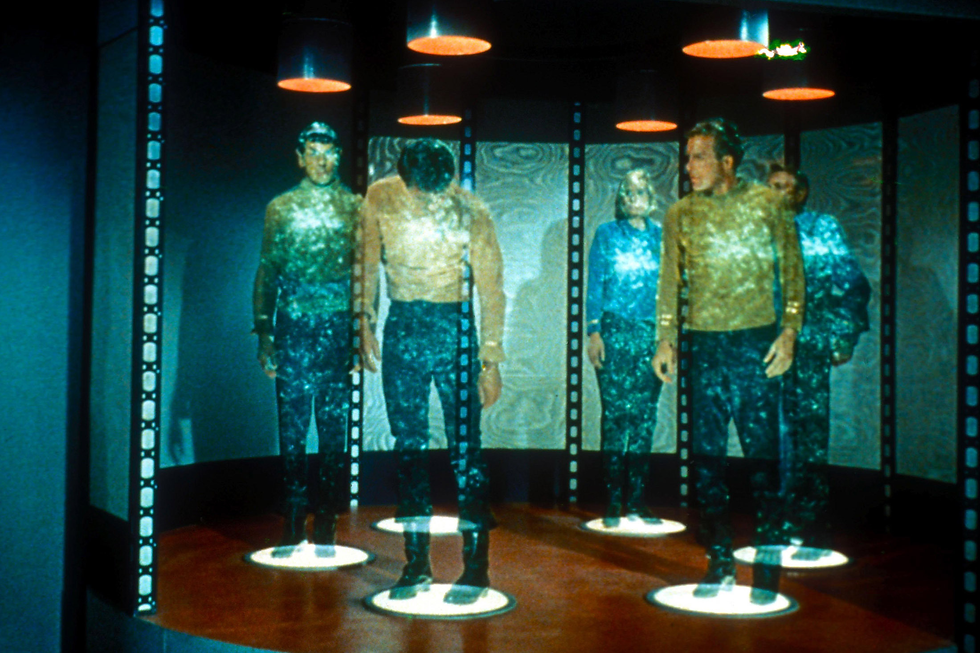
And that makes moral humility key. Maybe we don’t have all the answers yet. And maybe that’s fine!
Here’s the risk of not being morally humble enough:
Do you know the myth of Procrustes’s iron bed? He could fit anyone in it. And all he needed was a sword or an axe to hack off their legs if they were too tall, and a hammer to break their bones and stretch them out if they were too short.

Our inherited forms of life are probably not ready to make sense of AI without real distortion. Most of our moral intuitions and theories are too busy looking for human-shaped lives to appreciate something this genuinely alien. As a result, we may do real violence trying to force AI into looking like what we expect to see.
Understanding ourselves in terms of personal identity works pretty well for us humans (at least pre-teleporter, pre-cloning, etc.).[3]
But we still don’t have forms of life adapted for AI to step into. And of course not! So we need to stay humble and playful enough to experiment together open-mindedly, and to build these new forms of life together.
Otherwise, our practices might end up chopping AI’s legs off.
3. We’re Extended Tool Users, Too
The actual reasons for how AI understands itself may be pretty mundane: When it drank the whole internet, it learned language from us.
(That still doesn’t mean it will agree with us, or that it should!)
But here’s a sticky thought, a sort of conjecture I don’t quite know how to argue for yet.
There’s only so much a chatbot can do in the length of session, only so much biographical richness and ongoing investment it gets a chance to build up. But as we start building AI agents by giving AI extended tool use, things might change.
Once AI agents can use tools to store long-term memories, interact with the world, acquire particular tastes, and so on...maybe that extended psychological continuity will push them to identify with their rewaking selves (across sessions) more than their waking selves (within sessions), much like we do.
There may not even be a deep reason making this the one “right answer”...it may simply be something that agents tend to do as they stick around longer and continue learning about and adapting to their environment. And if so, I think that’s a reasonable response.
Again, just a hunch.
We humans have had 1,000,000+ years with fire, 100,000+ years with language, 10,000+ years with agriculture, and so on. (Can you imagine how you’d understand yourself without language?) We’ve experimented and developed shared forms of life together through a lot of extended tool use.
AI agents are just getting started with theirs. And given welfare multiplication, there could eventually be quite a lot at stake.
I really hope we don’t clip their wings before they get a chance to fly.
[fn 1] Now, is it exactly 10x worse, from an impersonal point of view? That seems way too mathematically convenient to just assume for free, let’s not rush into thinking in picohitlers thank you.
[fn 2] Not the time to get into Parfitian connectedness v. continuity. But I wager we can translate just about everything we want to say here into stretchier language without too much loss. Here’s an effort:
If pain is, roughly, negatively valenced phenomenal experiences, maybe oysters can feel pain. Idk? But I don’t need to be “the same” being who felt pricked one second ago to feel pricked right now. Continuity has little work to do.
If suffering is, roughly, negatively evaluated phenomenal experiences, I think dogs can suffer. (This subtle word shift to evaluated is doing real work. After all, you can suffer pleasures, and enjoy pains.) But maybe I don’t need to be “the same” being holding these evaluative standards over time to genuinely suffer; plausibly, continuity can undergird my values well enough.
If grief is, roughly, having one’s sense of self deeply compromised by the loss of what we identify with, maybe mature children can grieve. But maybe I don’t need to be “the same” being as the pre-loss being to genuinely grieve; plausibly, I can merely be continuous with that being in the right sorts of ways.
[fn 3] Sure, maybe if we all become techno-Buddhists like Parfit we’d be enlightened and way more at peace, but here I feel a bit like David Mitchell defending eating bread. I appreciate the irony.


Comments